
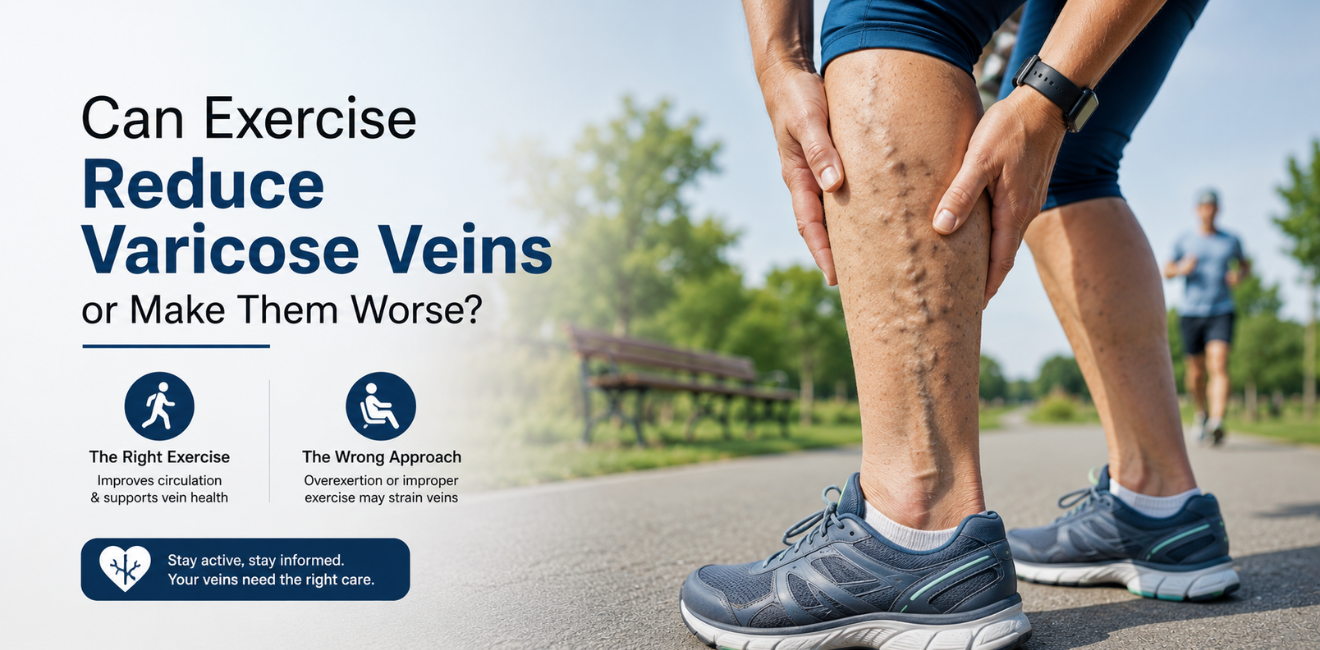
Can Exercise Reduce Varicose Veins or Make Them Worse?
Here’s a short and quick answer. Exercise will not make varicose veins disappear, but the right type will minimise and half their advancement, but the incorrect type will decrease and slows their advancement, but the incorrect type may worsen them.
Walking, swimming and cycling are all examples of mild, low-impact activities that get your blood flowing and ease tired legs. Heavy straining, such as what occurs during heavy weightlifting sets or deep loaded squats, has the opposite impact. It raises the pressure inside the vein, potentially pushing it further forward.
So you don’t have to stop exercising. You simply need to be a little more selective about which type. Allow me to walk you through what works, what you should skip, and what genuinely fixes the problem.
Why Exercise Matters for Varicose Veins
To understand why movement helps, it helps to know what is actually going wrong inside the leg.
Varicose veins happen when the small one-way valves inside your leg veins start to leak. Normally, those valves snap shut to keep blood flowing up toward the heart. When they weaken, some of that blood slips backward and pools, and over time, you get the bulging, ropey veins you can see and that heavy, achy feeling by the end of the day.
Your calf is the hero here. Think of it as a second pump. Every step you take squeezes the deep veins and pushes blood upward, which is exactly why movement helps varicose veins and why sitting still all day makes them feel worse. Can the gym undo the damage, though? No. But it can take the pressure off, calm the symptoms, and lower the odds of new veins showing up.
Can Exercise Make Varicose Veins Worse?
It can, yes, but only certain kinds. The Problem is straining. Anything the that causes you to clench your breath and bear down increases the causes you to tighten your teeth, hold your breath down increase the pressure in your stomach and legs, which presses directly on valves that are already straining.
The usual victims include:
- Heavyweight lifting and powerlifting, especially when you hold your breath during a rep.
- Deep loaded squats, lunges, and the leg press
- High-impact running and jumping on hard terrain.
- Hot yoga and Bikram, where the heat broadens the veins
None of this requires you to stop. Lighter weights, improved breathing, softer surfaces and a few strategic substitutions generally keep you in the game.
Best Exercises for Varicose Veins
These are the ones that work with your calf pump instead of against it.
Walking. If you only do one thing, do this. Walking is brilliant for varicose veins because every step pumps blood up and out of your legs, and you need nothing more than a decent pair of shoes. Half an hour most days is plenty.
Swimming and water workouts. The water hugs your legs like a gentle compression stocking while you move, so you get the pumping action and the squeeze at the same time, with zero stress on your joints.
Cycling or a stationary bike. Pedalling builds up the calf muscles and keeps things flowing. Start easy and add time as you go.
Calf raises and ankle pumps. Small, almost embarrassingly simple, and you can do them at your desk, on the sofa, even in bed. Perfect if walking is tough for you.
Gentle yoga and legs up poses. Skip the hot studio. Cooler, slower yoga and any pose that lifts the legs helps drain the blood that has settled.
Best vs Worst Exercises at a Glance
| Helpful for varicose veins | Best avoided or modified |
| Walking | Heavy weightlifting |
| Swimming | Deep loaded squats and lunges |
| Cycling | High impact running |
| Calf raises and ankle pumps | Crunches and sit ups |
| Gentle, non heated yoga | Hot yoga and Bikram |
Can Exercise Alone Get Rid of Varicose Veins?
This is the part people do not always want to hear. No amount of exercise will reverse varicose veins, because nothing you do at the gym can repair a broken valve. Once that valve gives out, the vein stays as it is. What movement can do, and do well, is keep you comfortable, hold your weight steady, and stop new veins forming, especially alongside compression stockings, putting your feet up, and not sitting or standing in one spot for hours.
If you actually want the visible veins gone, that calls for a minimally invasive treatment such as endovenous laser ablation (EVLA), radiofrequency ablation, or sclerotherapy. These gently seal the faulty vein so your blood simply reroutes through healthy ones, and the recovery is usually quick.
When to See a Vein Specialist
Most varicose veins are harmless, but now and then they point to something deeper called chronic venous insufficiency. It is worth getting checked if your legs ache or feel heavy a lot, if swelling lingers, if the skin around your ankle darkens or thickens, if a vein bleeds, or if you have a sore that will not heal. And do not sit on sudden calf pain, warmth, or swelling, since that can signal a clot.
Take the Next Step With Dr. Hiten Patel in Vadodara
If your veins are aching, spreading, or just wearing down your confidence, exercise is a great way to manage them, but real, lasting relief often needs a specialist. As a trusted vein specialist in Vadodara, Dr. Hiten Patel offers a careful assessment and modern, minimally invasive treatment built around you. If you have been searching for varicose vein treatment near me, book your consultation today and take the first step toward lighter, more comfortable legs.
