
PAD Treatment Options: Angioplasty, Stenting or Bypass: Which Is Right for You?
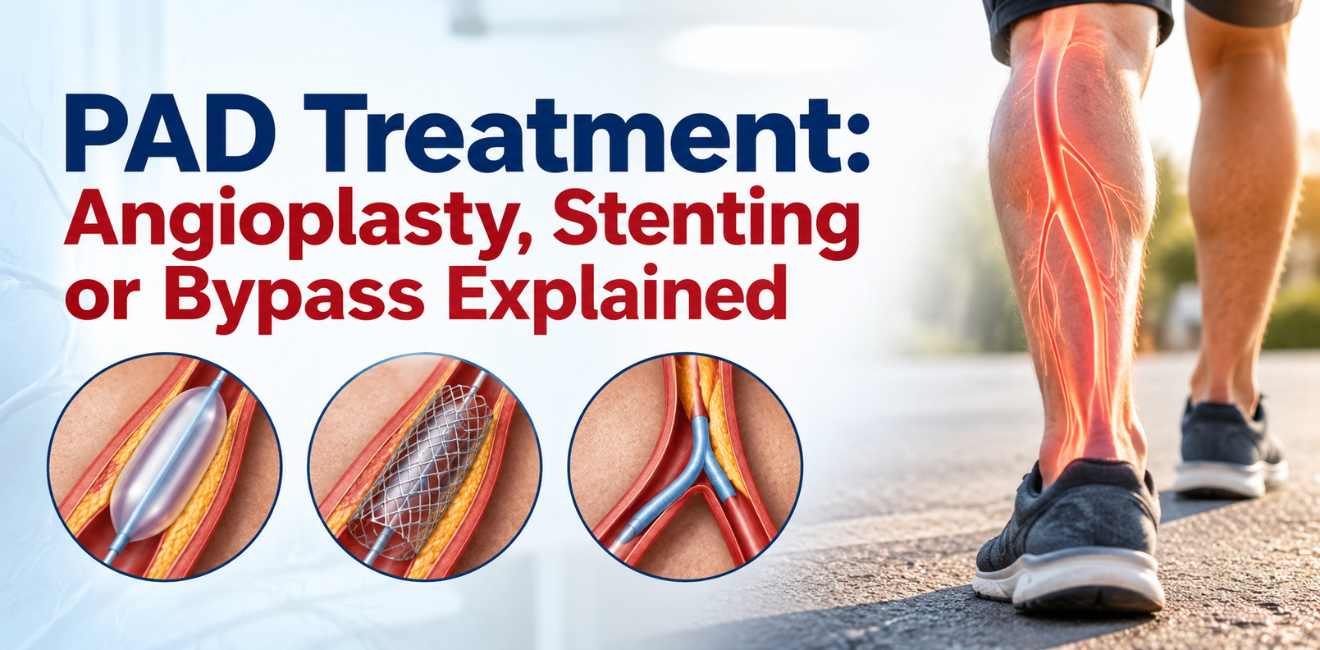
Quick answer: The three main PAD treatment options are angioplasty (a balloon opens the narrowed artery), stenting (a small mesh tube holds it open), and bypass surgery (a graft reroutes blood around a blockage). There’s no single “best” option – the right choice depends on where the blockage is, how long it is, and how severe your symptoms are. A vascular surgeon decides after imaging your arteries.
If you’ve been told you have peripheral artery disease (PAD), the word “treatment” can feel overwhelming. Angioplasty, stents, bypass – what do they actually mean, and how do doctors pick one over another? Here’s a clear, honest guide to your options and, just as importantly, how the decision gets made.
First, a Quick Recap on PAD
PAD happens when the arteries carrying blood to your legs become narrowed or blocked, usually by fatty plaque. Early on it causes claudication – leg pain or cramping when you walk that eases with rest. Left unchecked, it can progress to critical limb ischemia, where the foot hurts even at rest and wounds refuse to heal. If you want the full background on how this affects circulation, see our earlier guide on how PAD affects blood flow in the legs.
The point worth knowing: not everyone with PAD needs a procedure. Which brings us to where treatment actually begins.
Treatment Starts Before Any Procedure
For many people with mild to moderate PAD, the first line isn’t surgery at all. It’s a combination of supervised walking programs, quitting smoking, controlling blood sugar and cholesterol, and medications that keep blood flowing and plaque stable.
Done properly, these can improve walking distance and quality of life without any intervention. Procedures come in when symptoms are limiting your life despite these measures, or when the blockage is threatening the limb.
Option 1: Angioplasty
Angioplasty for PAD is the least invasive of the three. A vascular surgeon threads a thin catheter into the artery through a small puncture – usually in the groin and guides a tiny balloon to the narrowed spot. Inflating the balloon flattens the plaque and widens the channel, restoring blood flow.
It’s typically best for short, focal narrowings. Recovery is quick, most patients go home the same or next day, and there are no large incisions. The trade-off is that some arteries can narrow again over time, which is where a stent often comes in.
Option 2: Stenting
Think of a stent as scaffolding. After the balloon opens the artery, the surgeon places a small mesh tube that stays behind to hold the vessel open. Leg artery stenting is often combined with angioplasty when the artery is likely to collapse or re-narrow on its own, or when angioplasty alone doesn’t hold.
Like angioplasty, it’s part of the endovascular treatment family done from inside the vessel, minimally invasive, with a short recovery. Modern stents, including drug-coated ones, are designed to stay open longer. It’s a strong option for the right anatomy, though not every blockage suits a stent.
Option 3: Bypass Surgery
Peripheral bypass surgery is the most involved but sometimes the most durable. The surgeon creates a detour around the blocked segment using either one of your own veins or a synthetic graft, so blood flows past the obstruction entirely.
Bypass tends to be chosen when the blockage is long, when several segments are diseased, when endovascular attempts haven’t worked, or in advanced critical limb ischemia where saving the limb is the priority. Recovery is longer than with keyhole methods, but for complex disease a well-placed bypass can outlast the alternatives by years.
How the Right Option Is Actually Chosen
Here’s the part no honest blog can decide for you. The choice between angioplasty, stenting, and bypass depends on factors only proper imaging can reveal:
- Location and length of the blockage – short and focal favours angioplasty; long and complex often favours bypass
- Severity of symptoms – claudication versus limb-threatening ischemia
- Number of diseased segments – one narrowing versus several
- Your overall fitness – some patients aren’t candidates for open surgery
- Availability of a good vein for grafting
That’s why the real first step isn’t picking a procedure – it’s getting your arteries mapped with a Doppler ultrasound or angiogram so the plan fits your actual anatomy.
Comparing the Three at a Glance
| Feature | Angioplasty | Stenting | Bypass Surgery |
| Invasiveness | Minimal | Minimal | Open surgery |
| Best for | Short narrowings | Arteries prone to re-narrowing | Long or complex blockages |
| Recovery | 1–2 days | 1–2 days | Weeks |
| Durability | Good | Good to very good | Often longest for complex disease |
| Anaesthesia | Usually local | Usually local | General/regional |
When to See a Vascular Surgeon
Don’t wait for leg pain to become constant or for a wound to appear. If walking is limited by cramping, if your foot feels cold or looks pale, or if a sore isn’t healing, get assessed early – the earlier PAD is treated, the more options remain on the table and the better each one works.
Dr. Hiten Patel, vascular surgeon in Vadodara, offers the full range of PAD care at Aadicura Hospital – from non-invasive assessment and angioplasty to stenting and bypass surgery – and will recommend the option that genuinely fits your arteries, not a one-size-fits-all answer. Book a consultation today to find out where you stand.
